We've talked to dozens of MSP owners over the past two years. The conversation almost always starts the same way: "We do great work. Our clients love us. But we have no idea where next quarter's new business is coming from."
They've got 95% retention. They've stacked solid MRR. The technical side is dialed in. And their entire growth engine is four words: "Someone referred us."
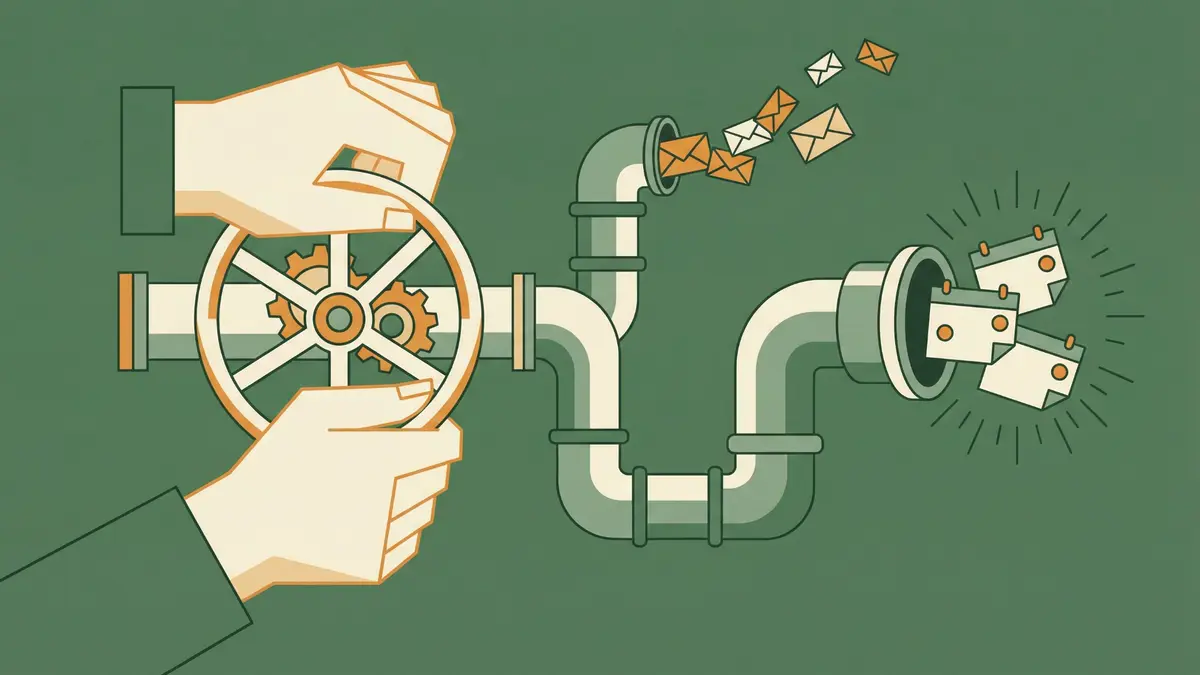
That's not a pipeline. That's a coin flip.
Why MSPs Get Stuck on Referrals (And Why That's Becoming a Problem)
Let's be honest — referrals are the best channel any MSP will ever have. They convert at absurd rates, cost nothing, and the trust is built in before you even pick up the phone. If you're getting referrals, don't stop.
But here's the structural problem nobody wants to confront: the managed services market is projected to nearly double over the next decade, from roughly $400 billion in 2025 to over $800 billion by 2033, according to Grand View Research. More SMBs need IT help than ever before. And yet Kaseya's 2025 Global MSP Benchmark Report found that one in three MSPs say acquiring new customers is their single biggest challenge this year.
Think about that. The market is growing — and MSPs are still struggling to fill pipeline.
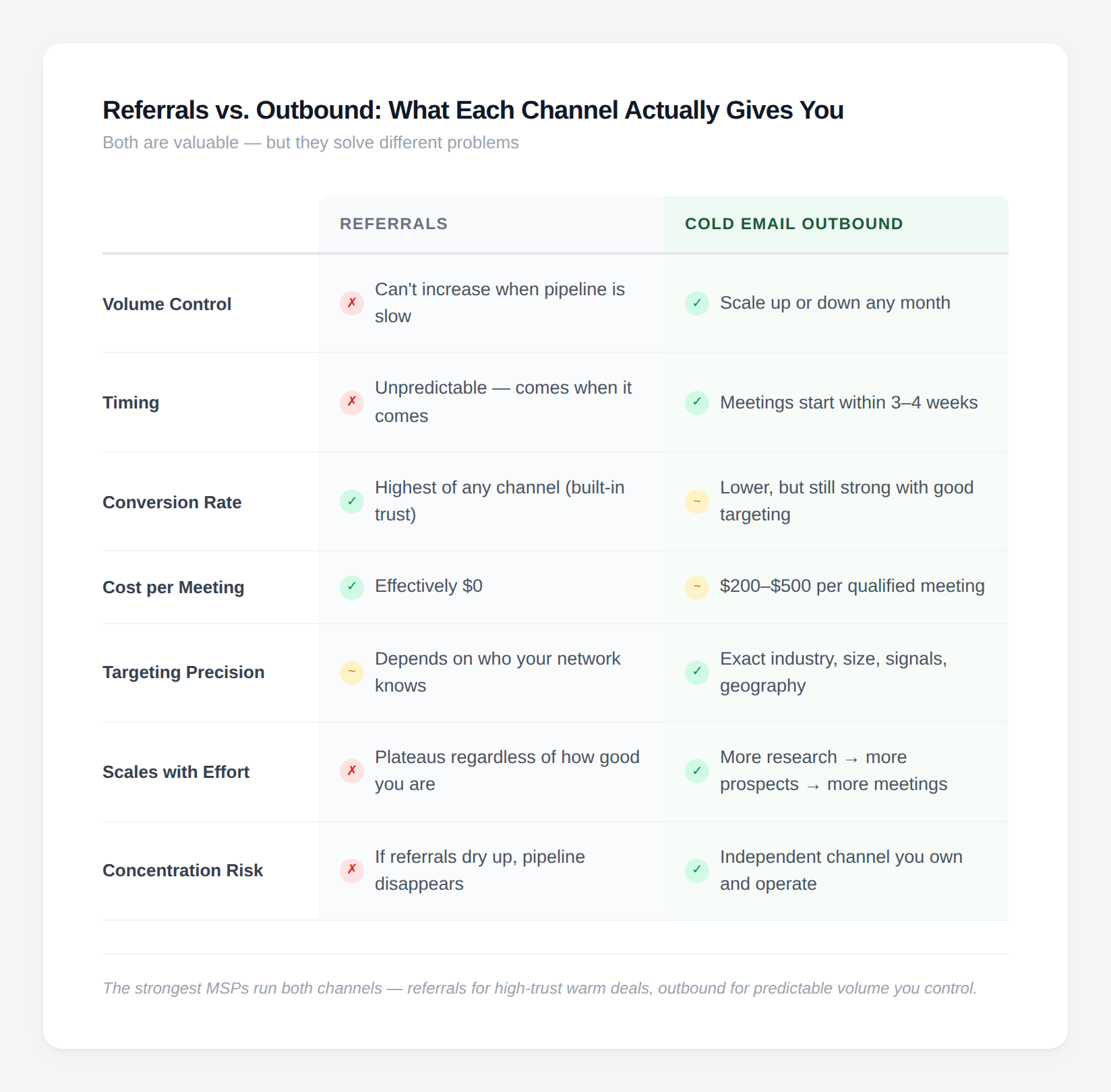
The reason is straightforward. Most MSPs were started by technical founders. You were a sysadmin, a network engineer, an IT director. You built something great, clients told their friends, and the business grew. But that growth model has a ceiling. You can't email your network and say "please send me three introductions this month." You can't turn referrals up when Q3 is slow. And when your biggest client suddenly cuts their contract — which happens — there's no backup. (This isn't an MSP-specific problem — we broke down why every services firm needs outbound alongside referrals, not instead of them.)
We wrote a full breakdown of why this pattern shows up across all professional services firms and how it breaks. For MSPs specifically, it's compounded by something else: your buyers are getting more emails from IT vendors than ever. Every cybersecurity company, every SaaS tool, every other MSP is pinging the same business owners. That noise makes it harder to stand out on referrals alone — but it also means that the MSPs who do outreach well have a massive advantage, because almost everyone else does it terribly.
What Cold Email Actually Looks Like for an MSP
When MSP owners hear "cold email," they picture spam. Bulk blasts with subject lines like "RE: Your IT needs" sent to purchased lists. We get it. That stuff is bad, it damages reputations, and it doesn't work.
What we're talking about is fundamentally different. It's closer to the conversations you'd have at a local business networking event — but at a scale you could never achieve in person.
Your prospects are specific. For most MSPs, the sweet spot is business owners or ops managers at companies with 20-200 employees. They don't have an internal IT team (or they have one overwhelmed person doing everything). They're in industries that need IT support but rarely build it in-house: law firms, accounting practices, healthcare clinics, real estate offices, manufacturing shops. You probably already know this intuitively — it's who your current clients are.
The signals that tell you someone's ready to talk. This is where targeted outbound beats referrals on precision. We look for trigger events that indicate a prospect is feeling the pain right now:
A company posting for IT roles — that's a signal they need help and might prefer outsourcing to hiring. A firm that just opened a second office or raised a round of funding — growth creates IT headaches fast. A business in a sector with new compliance requirements — ConnectWise's 2025 research found that 57% of SMBs now rank cybersecurity as their top priority, but most don't know how to act on it. That gap is an MSP's opening.
The messaging isn't about you. The biggest mistake we see MSPs make with cold email is leading with their services. "We offer managed IT support, cloud migration, and cybersecurity solutions for small businesses." That's a brochure, not a conversation starter.
What works is leading with something specific to the prospect's situation. Here's the difference:
The generic version: "We help growing businesses manage their IT so they can focus on what they do best." (Delete.)
The specific version: "I noticed you posted a systems administrator role last month — are you finding the right person, or would it be worth exploring whether outsourced IT support could fill that gap faster?" (Reply.)
We go deep on what makes cold emails actually get replies from business owners, including the specific angles that work for services firms. For MSPs, the angles that consistently perform are the compliance gap ("Are you confident you'd pass a SOC 2 audit tomorrow?"), the hiring signal (referencing an actual IT job posting), and the growth trigger (new office, new funding, expanding team).
Sequences are short. We send 3-4 emails over about two weeks. Not 7. Not 12. We tested longer sequences early on. After email 4, response rates cratered and spam complaints spiked. For MSPs selling $5K-$15K/month managed service agreements to skeptical business owners, fewer emails with more substance wins every time.
The Numbers: What to Realistically Expect
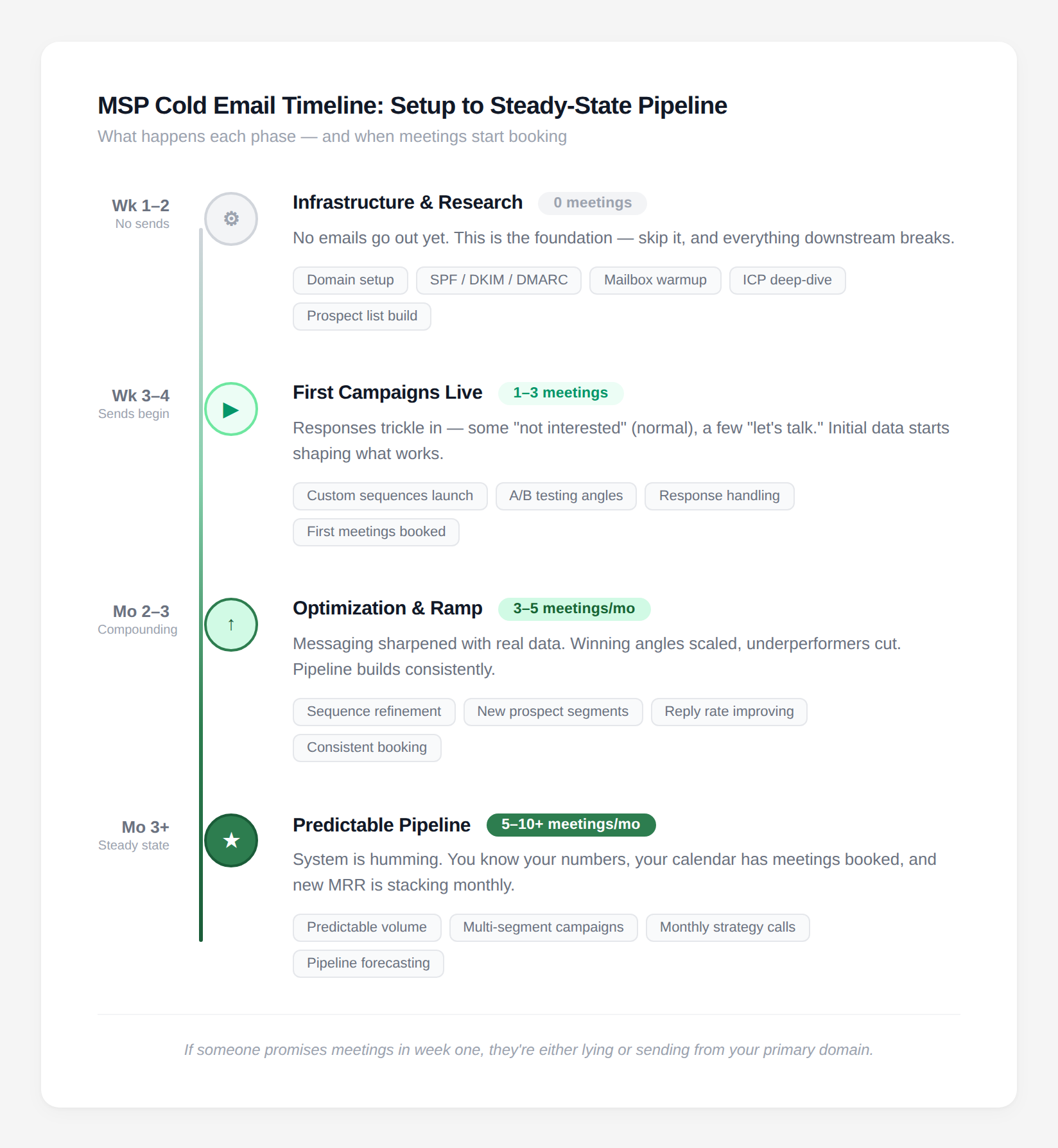
Here's what nobody in MSP lead gen wants to say out loud: this takes time, and the first two weeks produce zero meetings.
Weeks 1-2: We're setting up dedicated sending domains (your primary domain never gets touched), warming mailboxes, building your prospect list from scratch, and writing custom email sequences. If someone promises you meetings in week one, they're either lying or they're sending from your main domain — which will torpedo your deliverability.
Weeks 3-4: First campaigns go live. Responses start coming in. Some are "not interested" — that's normal and actually healthy. A few are "tell me more" or "let's talk." You're booking your first 2-3 meetings.
Month 2+: This is where it compounds. We've got real data on which subject lines, angles, and prospect segments are working. Messaging gets sharper. At steady state, most MSPs running a well-targeted outbound program book 5-10 qualified meetings per month.
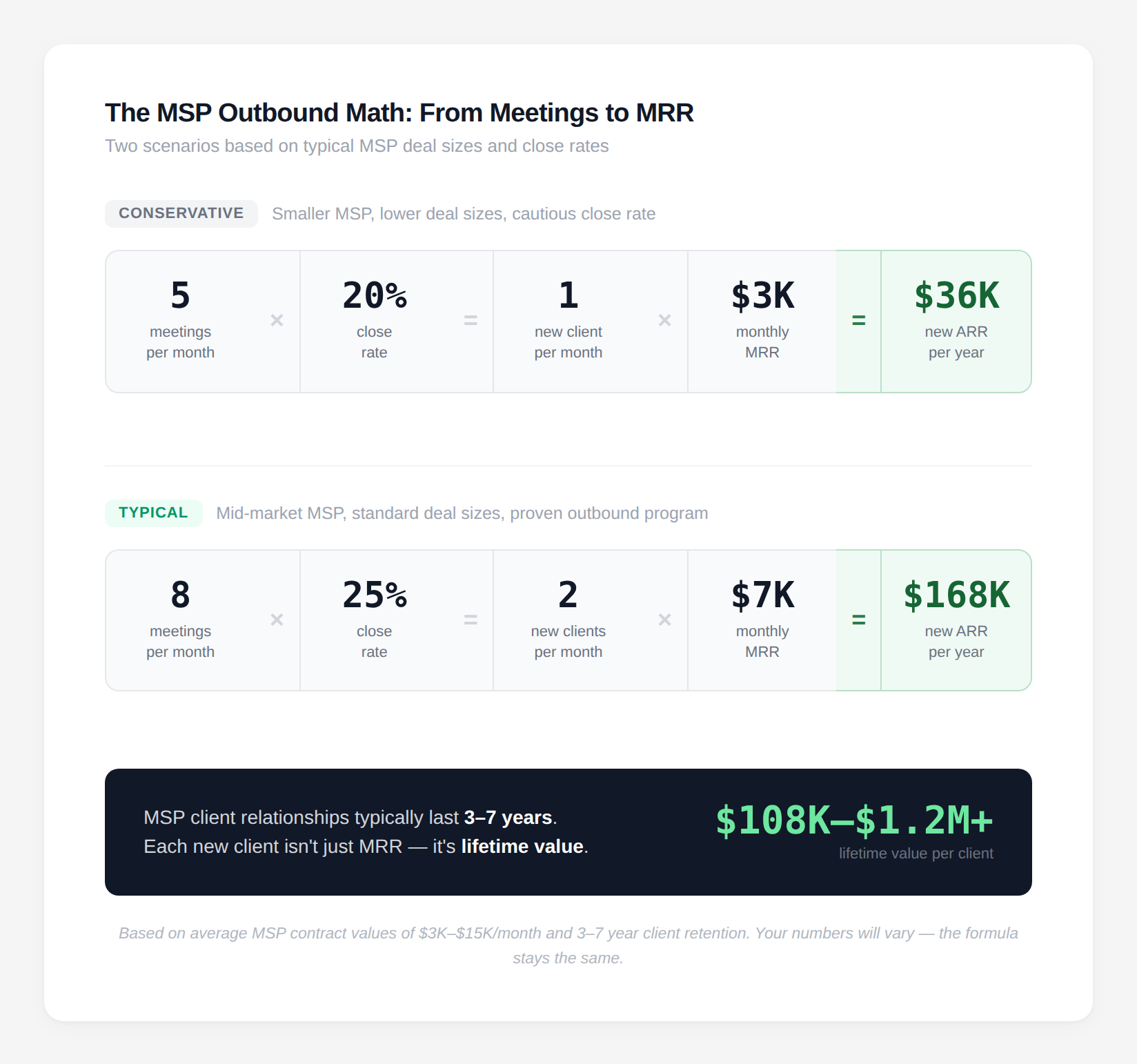
The math that matters: a typical MSP deal is $3K-$15K in monthly recurring revenue, with client relationships lasting 3-7 years. If outbound books you even 5 meetings a month and you close 20-30% of those, you're adding one to two new managed service clients every month. Over a year, that's $36K-$360K+ in new annual recurring revenue — from a channel that costs a fraction of a single sales hire.
We typically see 5%+ positive response rates for MSP campaigns. The industry average for generic cold email is under 1%. The difference is targeting and relevance — you can't shortcut either one.
"But Won't Cold Email Damage My Reputation?"
This is the objection we hear from nearly every MSP owner we talk to, and it's a smart concern. Your reputation in your local market is everything. A bad cold email with your name on it could genuinely hurt you.
Here's how we think about it.
Your primary domain never sends cold email. We set up secondary sending domains with full authentication — SPF, DKIM, DMARC — and warm them for two weeks before a single email goes out. If something goes sideways with deliverability (it shouldn't, but hypothetically), your main domain, the one clients email you on, isn't affected.
Volume is intentionally low. We're not blasting 10,000 emails. For a typical MSP campaign, we're sending to 1,000-2,000 researched, verified prospects — spread across weeks at 25-30 emails per mailbox per day. That's a pace that's invisible to spam filters and feels like natural business communication to recipients.
The emails don't feel like cold email. When someone reads a Firmwise email and thinks "huh, that's actually relevant to something I'm dealing with," you haven't damaged your reputation. You've enhanced it. The MSP owners we work with regularly get replies like "Thanks for reaching out, this is actually good timing." That doesn't happen with spray-and-pray.
One more thing worth acknowledging: some people will say "not interested" or unsubscribe. That's fine. It's a normal part of business outreach — every vendor your prospects work with got in front of them somehow. The goal isn't to be invisible. It's to be relevant.
Is Cold Email Right for Your MSP?
This approach works well if you sell managed service agreements worth $3K+ per month, your buyers are identifiable by company size and industry, and you (or someone on your team) can take sales meetings and close. If you're running a break-fix shop with $200 service calls, the math probably doesn't work — the deal size needs to justify the outreach investment.
It works especially well for MSPs in metro areas with a large addressable market of SMBs. If there are 2,000+ companies in your area that fit your ICP, there's more than enough to build a sustained pipeline. If you're in a town of 5,000 people, outbound may not be your best move.
And it works best alongside your referral network, not instead of it. We've seen campaigns where a cold email opens a door, and then a mutual connection walks through it. Or where a prospect who didn't reply to the email later saw the MSP owner at a local chamber event and said "Oh, you're the ones who emailed me — let's talk." The two channels reinforce each other.
If you're weighing whether to build this in-house or work with an outside team, we put together the full cost comparison between hiring an SDR and outsourcing outbound. The short version: an in-house SDR runs $55K-$70K in year one. Our pilot is $2,500.
The MSP market is growing. Your prospects need what you sell. The question isn't whether outbound works for MSPs — it's whether you'll be the MSP in your market that figures it out first.
Want to see how outbound works for your MSP? Book a 30-minute call — no pitch deck, no pressure, just a conversation about your pipeline.