
Referrals are probably the best growth channel your business will ever have. They close faster, cost nothing, and the trust is already built before you pick up the phone. If someone told you to stop taking referrals, they'd be an idiot.
But here's the problem we see over and over: firms that built their entire business on referrals eventually hit a ceiling. Not because referrals stop working — they keep working beautifully. Because referrals are the only thing working. And a single-channel business is a fragile business, no matter how good that channel is.
This isn't an argument against referrals. It's an argument against referral dependency.
Referrals Are Great. Referral Dependency Is Dangerous.
A Consulting Success survey found that 60% of consulting business comes from referrals and 63% of consultants rank referrals as their most powerful marketing channel. Those numbers don't surprise anyone who runs a services firm — of course referrals work. Research from Nielsen shows that 92% of people trust recommendations from someone they know over any other form of marketing. For professional services, where you're selling trust and expertise, that advantage is even more pronounced.
So what's the problem?
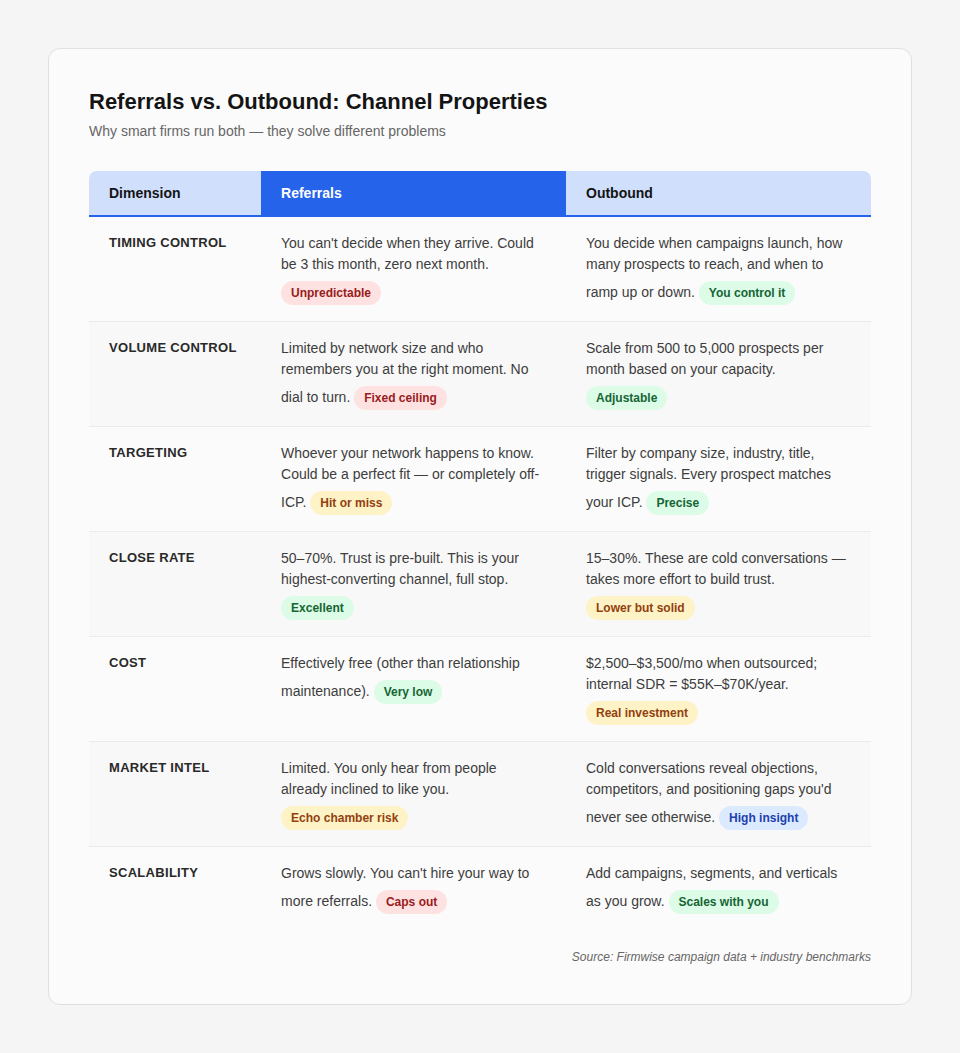
The problem is that referrals give you no control over three things that determine whether your firm grows or stalls: timing, volume, and direction.
Timing. You can't decide when referrals show up. We've worked with staffing agency owners who had two incredible months from a single client introduction, followed by four months of nothing. Not because they did anything wrong — because the person who referred them simply didn't have another connection to make. Referrals are lumpy by nature, and that lumpiness creates the feast-or-famine cycle that most services firm owners know intimately.
Volume. You can't turn a dial that says "send me 20% more referrals this quarter." You can ask, you can nurture your network, you can do great work and hope — but the throughput is fundamentally limited by how many people know you, remember you at the right moment, and happen to know someone who needs what you sell. Hinge Research Institute studied over 1,000 participants and found that even among firms that actively pursue referral marketing, the volume rarely scales linearly with effort.
Direction. Referrals send you whoever they happen to know. Sometimes that's a perfect fit. Sometimes it's a company half your ideal size, in an industry you don't specialize in, with a budget that doesn't make sense. You take the meeting anyway because it came through a warm intro. An hour later, you've learned nothing and helped nobody. When referrals are your only channel, you can't afford to be selective — and that has a real cost in time and focus.
Here's the pattern we've seen play out dozens of times: a firm grows nicely on referrals for three to five years. Revenue hits a plateau. The founder assumes they need to be "better at marketing," so they try posting on LinkedIn, maybe run some Google Ads, attend a few networking events. Results are inconsistent. They conclude that nothing works as well as referrals and go back to waiting. Growth stays flat — or worse, goes backward when a key client churns with no pipeline behind it.
The issue was never that marketing doesn't work for services firms. The issue was that they never added a channel with the properties referrals lack: predictability and control.
What Outbound Actually Adds (It's Not What You Think)
Most firm owners think outbound means choosing between cold email and referrals. That framing is wrong, and it's why so many hesitate to try it.
Outbound doesn't replace referrals. It fills the gaps that referrals can't.
Think of it this way. Referrals are the equivalent of fishing with a line — you catch good fish, but only when they swim by and you happen to be standing in the right spot. Outbound is more like knowing which part of the lake holds the fish you want and putting your boat there intentionally.
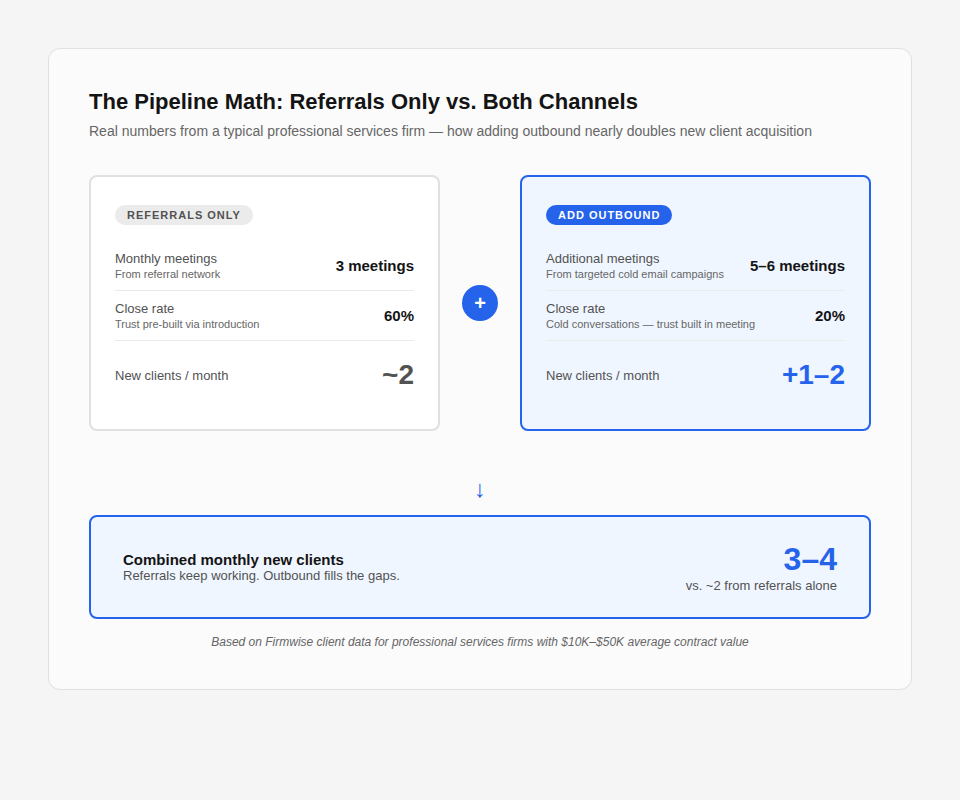
Here's what that looks like in practice. We work with an MSP whose referrals generate maybe 2-3 conversations a month with business owners who need managed IT services. Good conversations, high close rate. But 2-3 a month wasn't enough to grow — it was just enough to replace natural churn. We added outbound targeting companies with IT hiring signals — firms with 20-80 employees that had recently posted IT roles (the signal that they're struggling to manage IT internally). That one campaign added 5-6 additional conversations per month. The referrals didn't stop. Revenue grew for the first time in two years.
The meetings from outbound don't convert at the same rate as referrals — we're transparent about that. Referral-sourced opportunities typically close at 50-70%, while outbound-sourced conversations close lower, more like 15-30% depending on the vertical and deal size. But here's the math that matters: 3 referral meetings at a 60% close rate gives you roughly 2 new clients. Add 6 outbound meetings at a 20% close rate and that's another 1-2 clients. Your monthly new client acquisition nearly doubles — and unlike referrals, you can scale the outbound side up or down based on capacity.
The other thing outbound adds is market intelligence. When you're only talking to people who were referred to you, you have a skewed view of what the market wants. Cold conversations — with people who didn't already know your firm — reveal objections you've never heard, competitors you didn't know existed, and positioning gaps you couldn't see from inside your referral bubble. We covered the full picture of why outbound is hard for services firms and how to fix it — this article is about why it's worth fixing.
When the Two Channels Reinforce Each Other
Here's something we didn't expect when we started running campaigns for services firms: outbound actually makes referrals work better.
A consulting firm we work with sent a cold email to a COO at a mid-market company. No reply. Three weeks later, the COO mentioned to a friend that she was looking for an operations consultant. The friend said, "I know a firm — actually, I think they emailed you recently." The COO dug up the email, replied, and booked a call.
That meeting wouldn't have happened without both channels. The cold email planted the seed. The referral activated it. We've seen this pattern enough times that we don't think of outbound and referrals as separate strategies anymore — they're two parts of the same system.
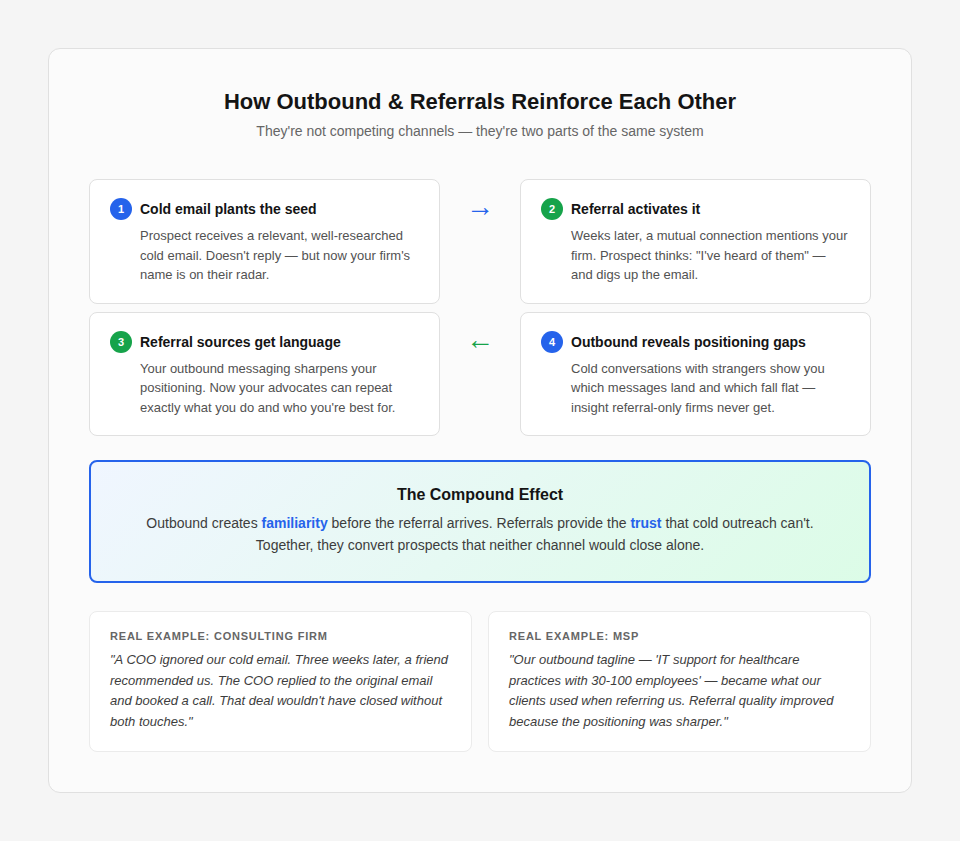
Outbound also gives your referral sources something to work with. When a past client wants to refer you but can't articulate what you do or who you're best for, the conversation stalls. If your outbound messaging has already sharpened your positioning — "we help staffing agencies with 20-80 recruiters build a second revenue channel through client acquisition outreach" — your referral sources can repeat that. Specificity is a referral accelerator.
Where This Doesn't Apply
Full disclosure — we sell outbound, so take our enthusiasm with the appropriate grain of salt.
Outbound doesn't make sense for every firm. If your average client is worth less than $5,000 a year, the math on outbound gets tight. If you're a solo practitioner who's already at capacity, you don't need more pipeline — you need to hire or raise prices. And if your buyers genuinely can't be identified by company type, title, or trigger signal (rare, but it happens), outbound targeting won't work well.
Referrals also remain the right primary channel for most services firms. We're not arguing for a world where outbound generates 80% of your revenue. For most of our clients, it's more like 30-40% — enough to smooth the volatility and keep the pipeline moving when referrals get quiet.
The goal isn't to abandon what built your firm. It's to make sure that what built your firm isn't also what limits it. If you're weighing whether to build outbound in-house or work with a partner, we broke down the full cost comparison. And if you're curious what cold email that actually works for services firms looks like in practice, we've published the specific angles and approaches that get replies.
Referrals got you here. Outbound gets you to the next level — without giving up anything that's already working.
Want to see how outbound works alongside your existing referrals? Book a 30-minute call — no pitch deck, no pressure, just a conversation about your pipeline.