We've talked to hundreds of services firm owners over the past two years. MSP founders, staffing agency partners, consultants, accountants. The firms range from 5 people to 50, from $500K in revenue to $10M+. And the pattern is almost always the same.
Great retention. Good margins. Clients who genuinely like working with them. And a pipeline that runs entirely on referrals and who-you-know.
That works — until it doesn't.
The Referral Ceiling Is Real
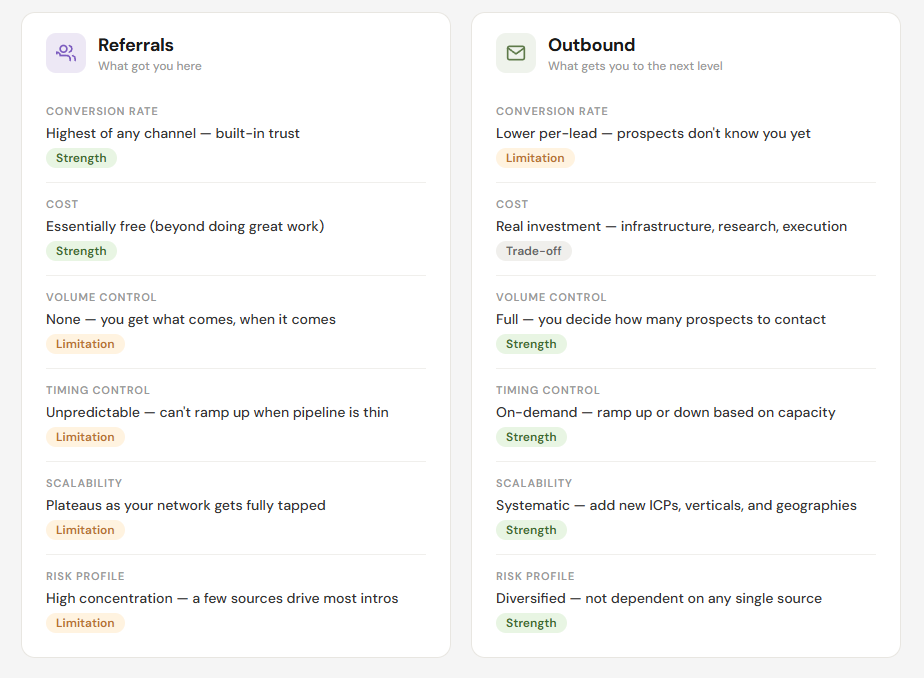
Let's be clear: referrals are incredible. They convert better than any other channel, cost nothing to acquire, and come with built-in trust. If someone told you to stop accepting referrals, ignore them.
But referrals have a problem that most firm owners don't fully confront until it hurts: you can't control the timing, the volume, or the quality.
A typical quarter at a referral-dependent firm looks something like this. January is slow because nobody was thinking about vendor changes over the holidays. February picks up — a former client mentions your name at a dinner. Two intros come in, one converts. March is great. April, nothing. May, your biggest client cuts their contract in half because of a budget shift you never saw coming. June, you're scrambling.
This isn't a failure of your service. It's a structural problem with the channel. Referrals are a byproduct of doing good work, not a system you can operate. You can't email your network and say "send me three introductions this month." Well, you can, but it won't work more than once.
The firms that grow past this ceiling all do the same thing eventually — they add a channel they can actually control. (We wrote a deeper analysis of why referral dependency is dangerous and how outbound complements it — the short version is that the two channels reinforce each other.)
Why Services Firms Specifically Struggle with Outbound
Here's what's interesting. Outbound — cold email, specifically — has been working for SaaS companies for years. It's practically a playbook at this point. But professional services firms have a much harder time making it work, and it's not because their buyers don't read email.
It's because most outbound advice is written for SaaS, and services firms are fundamentally different.
The buyer psychology is different. When someone buys a $50/month SaaS tool, the risk is low. When someone hires a $5,000/month MSP or a $30,000 consulting engagement, they're making a relationship decision. The email that works for selling project management software will actively repel someone evaluating a professional services partner. It's too salesy, too aggressive, too templated. Services buyers can smell inauthenticity from a mile away — because they sell services themselves.
The total addressable market is smaller. A SaaS company might have 500,000 potential buyers. A regional MSP might have 2,000. That means you can't play the volume game. You can't blast 10,000 emails and hope for the best. Every prospect has to be researched, and every email has to be relevant to their specific situation. This is more expensive and more time-consuming — but it's also why it works when it's done right.
The founder is the closer. In most services firms, the partner or founder takes the meeting and closes the deal. They're not sales reps — they're practitioners who also sell. That means the meetings need to be genuinely qualified and well-briefed. Dumping unvetted "leads" on a founder's calendar doesn't just waste time. It erodes their confidence in the whole approach.
The referral objection is real. Every services firm owner we talk to has the same concern: "Won't cold email make us look desperate?" This is a legitimate worry. Their reputation matters more than almost anything else. A bad cold email — generic, pushy, typo-ridden — can damage the brand they spent years building. The fear isn't irrational. It's just solvable.
What Actually Works (And What We've Learned Doesn't)
The fix isn't complicated in concept, but it's hard to execute — which is why most firms either don't try or try once, do it badly, and conclude that "outbound doesn't work for us."
Here's what we've seen actually work for services firms (and we go deeper on what makes cold email copy actually get replies):
Tight targeting over high volume. Instead of emailing 5,000 generic contacts, you research 1,000 prospects who match a very specific profile. For an MSP, that might be business owners at companies with 20-100 employees who've posted IT-related job openings in the last 60 days. That hiring signal means they're feeling the pain your client solves — right now. (We wrote a full MSP-specific playbook covering exactly how this works in practice, from targeting signals to realistic timelines.) For a staffing agency, it's companies with 5+ open roles on their careers page. For a consultancy, it's firms that just brought on a new VP of Marketing who's likely reevaluating vendors.
The targeting is the strategy. Get this wrong and nothing downstream matters. (We break down the specific email angles that work for each services vertical.)
Short sequences, not drip campaigns. We run 3-4 email sequences. Not 7, not 12. We tested longer sequences early on. Response rates after email 4 dropped off a cliff, and spam complaints went up. For a services firm, where the whole point is to start a professional conversation, fewer emails with more substance beats a long automated drip every time.
Prospect-specific angles, not mail merges. There's a massive difference between "Hi {{first_name}}, I noticed your company is growing" and "Hi Sarah, I saw you just opened a second office in Tampa — when firms expand like that, IT support usually becomes a headache fast." The first gets deleted. The second gets a reply. Not always, but at rates that actually build pipeline.
We're not talking about spending 20 minutes per email. It's more like 90 seconds of research per prospect — checking their LinkedIn, their company's careers page, recent news. Just enough to write an email that clearly wasn't sent to 5,000 other people.
Dedicated infrastructure, always. Never send cold email from your primary domain. Full stop. We set up secondary sending domains with their own SPF, DKIM, and DMARC authentication, warm them for two weeks before sending a single cold email, and cap volume at 25-30 emails per mailbox per day. Your main domain — the one your clients email you on — never gets touched. This is non-negotiable and it's the single biggest mistake we see firms make when they try outbound on their own.
Realistic Expectations (Because Nobody Else Will Give You These)
Most outbound agencies talk about "flooding your pipeline" and "10x-ing your meetings." Here's what actually happens for a services firm running a well-built outbound program (and if you're weighing whether to build this in-house or outsource it, here's the full cost comparison):
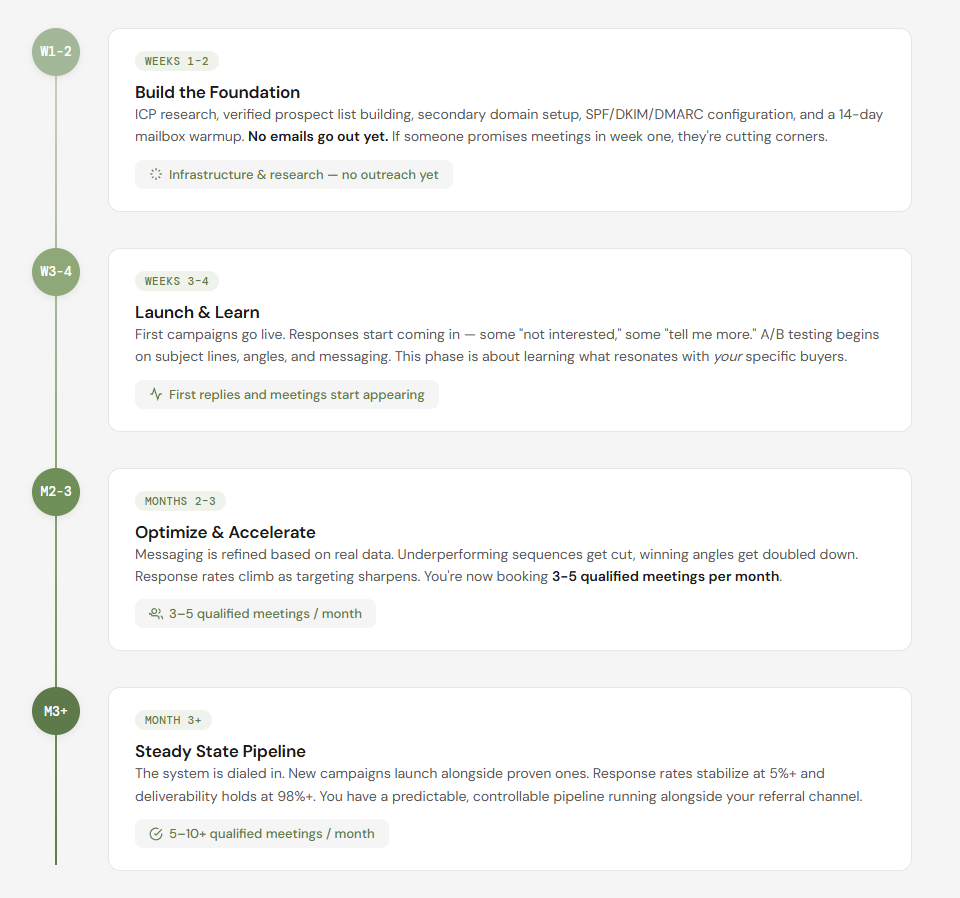
Weeks 1-2: Infrastructure setup, ICP research, list building, domain warmup. No emails going out yet. If someone promises you meetings in week one, they're either lying or sending from your primary domain.
Weeks 3-4: First campaigns launch. Responses start trickling in. Some are "not interested" — that's normal. A few are "tell me more" or "sure, let's talk."
Month 2-3: This is where it gets interesting. Sequences are refined based on real data. Response rates improve as messaging gets sharper. You're booking 3-5 qualified meetings a month.
Month 3+: At steady state, a well-targeted outbound program generates 5-10+ qualified meetings per month for most services firms. Not hundreds of "leads." Meetings — with real decision-makers who agreed to talk because something in your email was relevant to them.
The numbers that matter: we typically see 5%+ positive response rates for services firms (the industry average for generic cold email is under 1%), and 98%+ email deliverability. But the number that actually moves the needle is meetings booked — because meetings are what turn into revenue.
The Shift: From Hoping to Operating
The real change isn't tactical. It's mental.
Referral-dependent firms operate in a reactive mode. A lead comes in, you pursue it. No lead? You wait. Maybe you post on LinkedIn, maybe you go to a networking event, maybe you ask a friend for an intro. It works often enough that you never build anything else.
Outbound flips this. It's a system — with inputs you control, outputs you can measure, and a feedback loop that tells you what's working. You decide how many prospects to contact this month. You decide which industries to target. You decide when to ramp up and when to hold steady.
That doesn't mean it replaces referrals. Our best-performing clients still get referrals alongside their outbound pipeline. Sometimes an outbound email opens a door that a warm intro later walks through. The two channels reinforce each other.
But only one of them works when you need it to.
Is This the Right Approach for Your Firm?
Outbound works well if your average deal value is $10K+ annually, your buyers are identifiable by title and company type, and you have someone available to take meetings and close. It works especially well for MSPs, staffing agencies, consultancies, and accounting firms — because those buyers respond to substance over flash. K-12 is another strong vertical — school decision-makers are identifiable, deal values justify outreach, and the inbox is far less crowded than standard B2B. See our K-12 outbound breakdown for how the sourcing works.
It doesn't work if you're selling a $500 service, if your buyer can't be targeted by company characteristics, or if nobody at your firm can take a sales meeting. And it doesn't work if you expect results without giving it 4-6 weeks to build momentum. If the approach sounds right but you're unsure about hiring an SDR vs. outsourcing the whole thing, we broke down the full math.
If your firm grew on referrals and you're feeling the ceiling — the uneven quarters, the concentration risk, the anxiety when a big client goes quiet — you don't need to abandon what got you here. You just need to add a channel you can control.
Want to see how outbound works for your firm? Book a 30-minute call — no pitch deck, no pressure, just a conversation about your pipeline.